Seven years is a lifetime in football. Seven years ago, Massimiliano Allegri was rightfully judged as one of the best managers in the world. Right now? Many debate whether the former Serie A champ still has what it takes to succeed at Napoli.
But just what tactics has he been employing for the Partenopei? And how likely is it that Allegri will find success again?
This is what I’ll try to answer, hopefully drawing on my decade of experience writing football tactical analysis.
Use this information! SIGN UP for FootballCoin! The daily fantasy football game includes all Serie A matches and rewards the best managers daily.

Career Prior to Managing Napoli
Was Massimiliano Allegri ever a footballer? Yes, and a talented footballer at that. A creative midfielder, Allegri scored 56 goals over a near two-decade career with clubs like Pescara, Perugia, and briefly, even Napoli.
He took up management in 2003, immediately after retirement as a player. Allegri spent his first years in his new job building up his chops and managing lower-tier clubs. He got the call to manage Cagliari in 2008 and impressed. He managed AC Milan and won his first scudetto in 2010.
Next came Allegri’s “golden period,” managing one of the best Juventus sides in recent decades to five straight Serie A titles, and two UCL finals.
Since then? Now much, and certainly less than expected. Allegri has taken jobs with his former clubs, Juventus, AC Milan and now Napoli, but has failed to impress at either one, in my estimation.
Tactical Philosophy
Football managers are typically of their time. They are defined by the era they came up in. That’s why throughout his career, Allegri has remained tied to a pragmatic, defensive-first style of football that made Italian football very successful during the 1980s and 90s.
Allegri isn’t one for experiments or innovation. He wants a structured system, prefers playing in a low block and likes defenders who know their place and role in the team. However, Allegri also likes to give a few of the more gifted attacking players license to roam and showcase their creativity. Think this is too basic a method? Tell it to the man who has won six Scudettos!
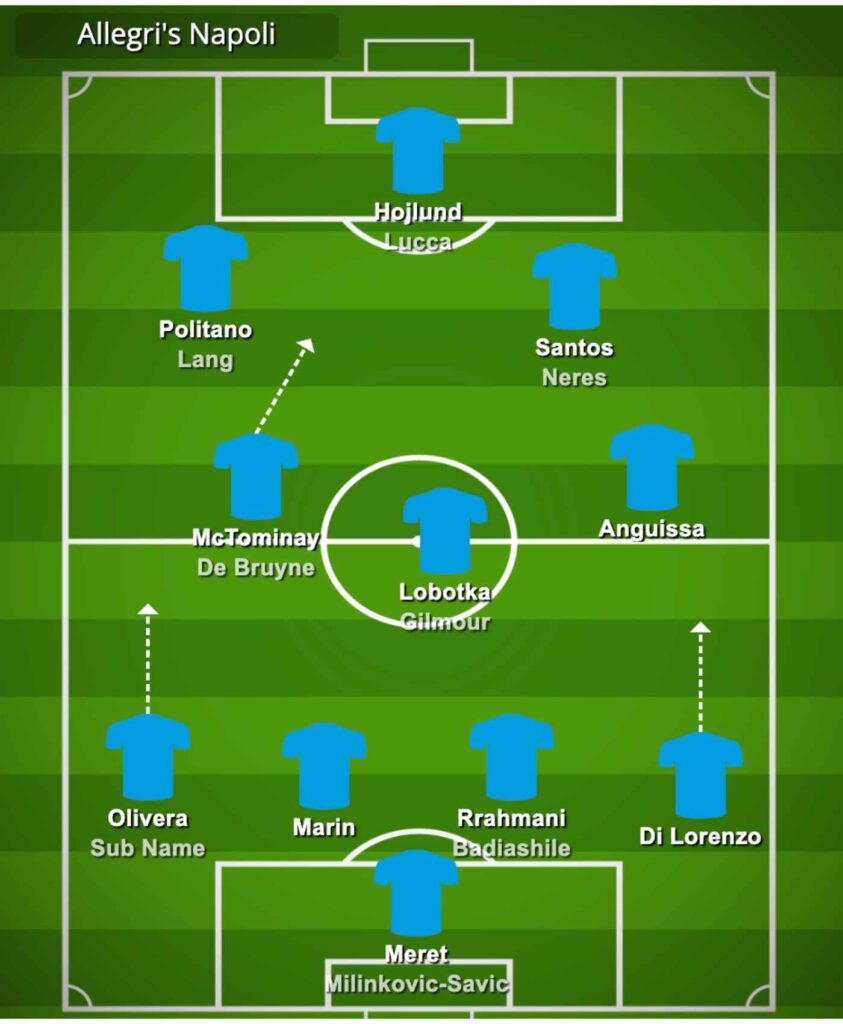
Formations and Adaptability
Yes, Allegri is one of the managers who grew up in the era of the low-block 4-4-2. He also knows the strength of a classic 4-3-3 where the wingers play wide.
This season, he’s struggled to settle on a formation for Napoli. He’s usually played a 4-3-3. However, he’s also matched his opponents with a 4-2-3-1 on a few occasions and has even tried playing three men at the back, as Antonio Conte, the former manager, did.
Transfers
Not many! Napoli’s owner Aurelio De Laurentiis is notoriously careful with the team’s finances. Allegri has also not demanded many transfers in.
Instead, Napoli has made the signing of Rasmus Hojlund and Alisson Santos permanent. They’ve brought in Vanja Milinkovic-Savic as a back-up keeper. They’ve also called back loan players like Noa Lang and Lorenzo Lucca.
Objectively, this is not a vintage Napoli squad, although there is clear talent here.
Napoli in Defence
It should be noted that Massimiliano Allegri’s greatest success, with Juventus, came after inheriting a team built by Antonio Conte. In some ways, the same thing happens this season.
Defensive control is central to Allegri’s playing style. How is he applying this strategy to Napoli?
Allegri has a strong core of players to rely on. In Giovanni Di Lorenzo and Amir Rrahmani, in particular, he has two bona fide team leaders.
Napoli can soak up pressure. Typically, Allegri employs a low block. Out of possession, the team’s shape resembles a 5-4-1. The central defenders play almost like a sweeper-back duo. Full-backs tuck in. The centre of the pitch is blocked up. The striker isn’t expected to press too hard against the build-up.
Where’s the ball actually won back and by whom? Usually in midfield by players like Frank Anguissa or Stanislav Lobotka. Allegri relies more on his players’ tactical acumen than on speed or aggression.
Allegri’s Build-Up Play
Napoli has some of the best midfielders in Serie A. The starting players have largely played together for years. Besides, Allegri likes to allow his more technical players the freedom to create.
The team builds up patiently against weaker opposition. Central defender Rrahmani will usually play the first pass onto Anguissa or Scott McTominay.
Against tougher opposition, for example, the recent match against AS Roma, Allegri encourages direct passing toward the tall Danish striker, Rasmus Hojlund.
Allegri’s Napoli in Attack
Frankly, I think that here, also, you can split Napoli’s attacking patterns into two types: the ones employed against lesser opposition and the ones used against the top teams.
In easier-to-win games, Napoli will build up slowly using Lobotka as the player who drops down to pick up the ball. He’ll then try to play toward Anguissa or McTominay (or Kevin de Bruyne, when not injured), Napoli’s more creative midfielders.
Napoli, however, has struggled to turn possession into goals this season.
The other approach, used more in recent games and against tougher opposition, involves direct passing. Here, the crafty full-backs, Di Lorenzo and Leonardo Spinazzola, will advance and tuck in. McTominay is allowed to play almost like a trequartista and given license to roam. Meanwhile, the pass will be played onto Hojlund, who plays as a classic target man in a supporting role.
What’s Next for Allegri and Napoli?
As I write this, Napoli just secured an important UCL victory against Bodo/Glimt, a draw against Roma and is about to play Venezia. It looks like the team’s form, poor throughout the season, may have turned a corner.
Yet Allegri still has a lot to prove if he wants to remain a top manager. Meanwhile, Napoli looks to have lost the momentum of their two recent Serie A wins. Both, however, have the potential to do better and to still achieve great things, in my opinion.