Time wears on a man. Ruben Amorim was leading Sporting to Champions League success, seemingly just yesterday. Now, he’s fighting for his reputation.
What tactics is the notoriously stubborn Portuguese manager bringing to AC Milan? And what is the likelihood that they’ll result in success?
This is what I’m looking to answer, drawing on my decade of experience writing football tactics analysis.
SIGN UP! FootballCoin‘s fantacalcio is ready to reward you for your skills as a fantasy football manager.

Career Prior to Managing AC Milan
Have you already forgotten about Ruben Amorim’s impressive career? Managing Manchester United for a while can make you forget that.
Amorim wasn’t exactly a star. His skill, however, allowed him to play alongside great stars. He was a versatile, tough defender who spent most of his career in Portugal’s top tier. As a player, Amorim won three Primeira Liga titles with Benfica and earned 14 national team call-ups.
However, Ruben Amorim’s managerial career has been much more eventful. Seen as a tactical revolutionary (we’ll see about that!), he quickly rose through the Portuguese ranks and joined Sporting in 2020. There, he rebuilt the squad and restored the team’s confidence. Amorim won two Primeira Liga titles as a manager and by 2024 was being courted by numerous clubs in Europe’s top leagues.
Amorim joined Manchester United in 2024 in a high-profile move toward innovation and renewal. Although he led the team to a Europa League final, he was dismissed in 2025.
Many saw Amorim’s appointment as manager of AC Milan as a big surprise.
Tactical Philosophy
Most football fans believe that Ruben Amorim is tied to a particular football philosophy. I don’t think that’s always the case.
Sure, he did build his early success in Portugal around a 3-4-3 formation and building up from the back using inverted wing-backs and two midfielders attacking the half spaces. Yes, he forced a similar structure onto Manchester United to varied success.
And yes, it’s true that Amorim encouraged relentless counter-pressing and an aggressive mid-block.
However, he’s shown he’s willing to tweak all of these things as manager of AC Milan.
Let me explain why these small changes are important.
Formations and Adaptability
Amorim is, perhaps, one of the most famous managers to use formations centred around three defenders. He used a 3-4-3 with Benfica and a 3-5-2 or 3-4-3 with Manchester United.
Still, Amorim has shown a willingness to adapt.
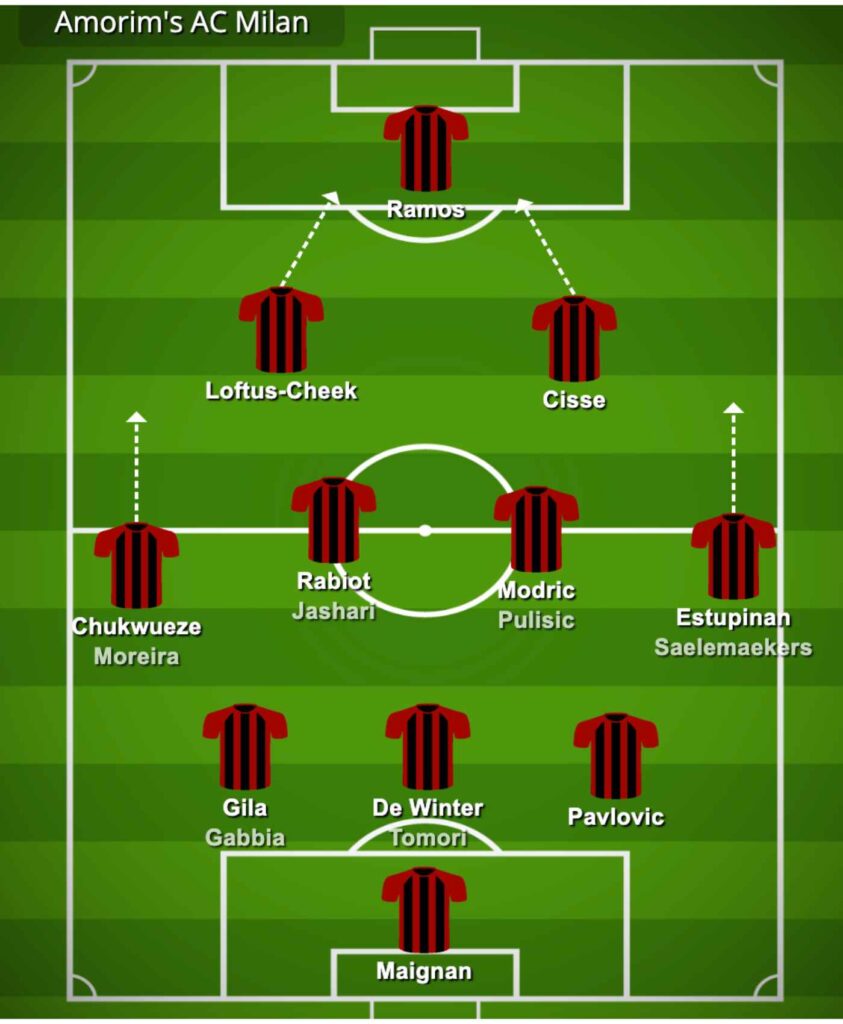
With AC Milan, he has tended to play in a 3-4-2-1, knowing that he can control possession and use Luka Modric’s skill on the ball. However, he has switched to a 4-4-2 against opposition willing to press more and run more miles.
Transfers
Amorim is a manager who requires certain types of players. Typically, they’re expensive.
That’s why the club has opted to sell players like Rafael Leao. Instead, he has brought in striker Goncalo Ramos, midfielder Diego Moreiro and centre-back Mario Gila. They’re all young, high-potential players, and these transfers have set Milan’s owners back € 164 million.
AC Milan in Defence
I’ve been quite impressed with AC Milan’s reactive nature. At the moment, Amorim is flexible with his instructions from one game to the next.
What’s the default setting? Amorim’s Milan plays in a mid-block, typically defending in a 5-4-1 where the wide midfielders are asked to track back, limit space and lock out passing lanes.
The pressing is somewhat less aggressive than it was at Sporting. Usually, he’ll use pressing triggers, most of the time against players in wider areas.
Amorim’s trying to build a tough, aggressive side in defence. You’ll often see the likes of Strahinja Pavlovic or the young Davide Bartesaghi diving into tackles. You’ll usually see the defenders winning their aerial duels.
Yet, this team also moves with the opponent, trying to match their shape and react to their strengths.
Ruben Amorim’s Principles for Build-Up Play
His build-up style is also well-known and heavily debated. Ruben Amorim likes his team to set up in a 3-4-3 when attacking. He likes one defensive midfielder to drop down to intercept the pass. Most importantly, he wants his wing-backs to charge upfield and create passing opportunities or, simply, to offer space for the striker and the attacking playmaker.
In some ways, AC Milan’s squad is better positioned to play this style. Pervis Estupiñán has the work rate and passing ability to play the more defensive full-back role. He hasn’t done great this season, but can improve. Meanwhile, Samuel Chukwueze’s speed and dribbling allows to aggressively attack the right flank, while new recruit Mario Gila can take over on the flank when fighting a counter-attack.
The secret weapon, of course, is often Luka Modric. The Croatian is now 41. While he’s lost some stamina, his vision and passing are still virtually unmatched.
Amorim’s Milan in Attack
Ruben Amorim has invested most of his transfer budget and time in transforming the team’s attacking department. Doing this, surely, is, in part, a reaction to his lack of success at Manchester United.
His attacking approach has changed very little from his time at Sporting.
Amorim will, typically, play one striker (Goncalo Ramos) and two inside forwards (Ruben Loftus-Cheek and Alphadjo Cisse). The inside forwards are meant to play in the half spaces connecting the midfield to the attack. Ideally, this, together with the wing-backs and playmaker, is meant to force the opposition to make quick decisions about who to mark and which passing lanes to cut out.
Ramos is a different striker from Victor Gyokeres, the number nine that brought Amorim such success with Sporting. Ramos can hold onto the ball and support the inside forwards. However, where Gyokeres was all about strength and positioning, the Portuguese relies more on technique, discipline and old-fashioned running.
However, Milan’s goals, at the moment, are coming from midfielders Adrien Rabiot or Diego Moreira. The attack is a work in progress. I think that Milan has the personnel required to make Amorim’s plans work.
What’s Next for Amorim and for AC Milan?
I admit to not being completely sold on the idea of Ruben Amorim taking on this AC Milan side. However, I’ve been relatively impressed.
Yes, Amorim is stubborn in his ways. At times, his attitude can seem selfish. But why shouldn’t he be this way? He has earned a reputation as a manager who can drastically change a club if given enough time.
AC Milan, on the other hand, is one of the most important clubs in the world, but it clearly needs a new and extensive rebuild.
The verdict? It’s too early to tell for sure, but things seem to be moving in the right direction for both the club and the manager.